PRESS, TAP, BLEND
A makeup blending sponge is not an eraser; it is a pressure-activated hydraulic damper. Understanding moisture retention, foam porosity, and edge orientation prevents foundation line demarcations and minimizes pigment loss.
 HYDROPHILIC EXPANSION
Why Water Displacement Controls Product Yield
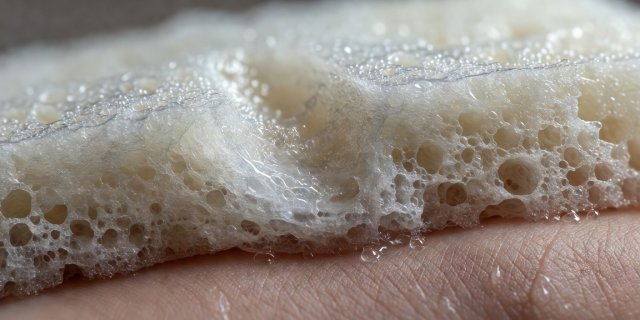
Hydrophilic polyurethane foam has high water affinity. When fully submerged and kneaded under running water, water molecules bond to the interior polymer cell walls, expanding the entire sponge matrix.
Because the sponge is already saturated with water internally, liquid foundation cannot penetrate into the deep core. Instead, the cosmetic formula remains suspended on the exterior micro-surface, transferring directly onto the skin with 80% higher efficiency than using a dry sponge.
The Towel Compression Rule
Squeezing with your hand alone leaves uneven water pockets inside the sponge, which can dilute foundation formulas on contact.
The Gold Standard: Wrap the rinsed sponge in a clean microfiber cloth or dry paper towel and squeeze firmly twice. This leaves the foam cool and damp without any dripping water droplets.
MATCHING SPONGE FACETS TO FACIAL ANATOMY
Different sponge geometries address specific structural zones on the face. Choosing the right facet improves precision and speed.
Seamless Gradient Bounce
The rounded bottom distributes broad passes across cheeks, jawlines, and forehead. The seamless circular profile ensures there are no sharp edges to imprint harsh foundation lines on skin.
Flat Stamping & Baking
The flat diagonal face acts like a stamp for setting loose powder under the cheekbones and beneath the eyes, producing crisp demarcation lines for sharp contour definition.
Periorbital & Nasolabial Creases
With an apex diameter under 6mm, micro-sponges reach the tear duct recess, the lateral flare of the nostrils, and blemishes without disturbing surrounding base makeup.
| Sponge Shape | Density & Firmness | Best Paired Formula | Target Coverage Level |
|---|---|---|---|
| Teardrop Original | Ultra Soft / Fast Rebound | Hydrating serum & radiant tints | Sheer to Buildable Medium |
| Flat-Edged Miracle Cut | Medium / Moderate Bounce | Full-coverage matte liquid | Complete High Coverage |
| Silicone-Core Hybrid Sponge | Firm Center / Soft Foam Exterior | Cream stick foundation & balm | Max Coverage / Zero Absorption |
| Velvet Microfiber Flocked Sponge | Firm / Micro-bristled shell | Dual-use wet/dry powder foundation | Velvet Airbrushed Matte |
HYGIENE PROTOCOLS AND REPLACEMENT CYCLES
A damp sponge is warm, porous, and loaded with skin lipids—an ideal environment for microbial proliferation if not managed with care.
Daily Soap Cleanse
Clean your sponge after each use with a solid bar soap containing tea tree or mild plant surfactants. Solid cleansers break down wax binders in long-wear foundations more effectively than diluted liquid soaps.
Rinse until water squeezes clear without foaming bubbles, then compress with a clean dry towel.
The 90-Day Structural Degradation Limit
Even with rigorous daily washing, polyurethane cell walls fatigue from repeated mechanical compression. After roughly 90 days of daily use, micro-tears emerge on the skin-contact facet, creating uneven texture pickup and harboring stubborn debris.
Replace your sponge as soon as surface flaking or firmness loss appears.