CHOOSE THE RIGHT FIBERS
Every makeup brush is an engineering tool designed to load, hold, transfer, and disperse microscopic pigment flakes. The diameter of individual filaments, the shape of the ferrule, and the tuft geometry dictate your final skin coverage far more than product price.
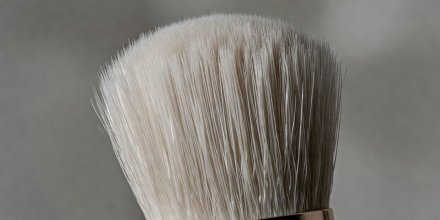 SYNTHETIC POLYBUTYLENE TEREPHTHALATE (PBT)
Engineered Synthetic Filaments
Modern micro-tapered synthetic filaments feature etched microscopic ridges along their shafts to mimic natural hair scale structure without absorbing oils. Because synthetics lack an internal cortex, they do not swell when exposed to water, oils, or alcohols.
Ideal Application: Heavy cream contour, silicone fluid foundations, water-resistant gel eyeliners, and cream blush formulas.
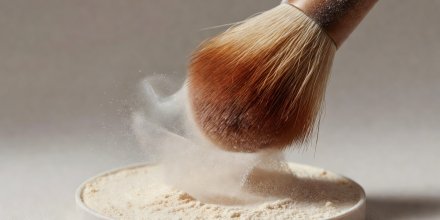 NATURAL CUTICLE MICROSCOPY
Natural Hair Mechanics (Saikoho Goat & Squirrel)
Natural animal hairs possess microscopic overlapping cuticles that physically grip loose powder spheres and release them gradually as pressure is applied to the skin. This controlled release produces an airbrushed, blurred finish that is difficult to recreate with smooth, untreated nylon bristles.
Ideal Application: Highly pigmented matte blush, finely milled setting powders, and featherweight eye shadow blending.
ANATOMY OF A PROFESSIONAL MAKEUP BRUSH
Beyond hair selection, the mechanical construction of the ferrule controls how pressure transfers from your hand to the client's facial planes.
Pinch Crimping
A flattened, oval ferrule forces filaments into a directional chisel shape. This concentrates bristle pressure along a thin line, making it suitable for sharp jaw contouring and precision crease carving.
Round Ferrule
Circular ferrules provide omnidirectional flexibility. Bristles splay equally in 360 degrees when pressed, making round heads the standard for diffused buffing and circular blending motions.
Bristle Trim vs. Hand-Shaped
Budget brushes are bundled and laser-cut across the top, blunting the tips and creating a scratchy feel. Hand-shaped brushes retain intact, tapered tips for gentle glide across sensitive eyelids.
| Brush Silhouette | Tuft Flexibility | Target Formulation | Handling Technique |
|---|---|---|---|
| Flat Top Kabuki | Rigid / Low Flex | Liquid and Cream Base | Perpendicular stipple; minimal dragging |
| Tapered Candle / Flame | High / Springy | Loose Setting Powders | Rolling sweep across T-zone and under-eyes |
| Angled Chisel Cheek | Medium / Directional | Pressed Bronzer & Contour | Linear sweep along zygomatic bone |
| Dome Buffing Eye Brush | Medium / Radial | Powder Transition Shadows | Windshield wiper back-and-forth micro-rotations |
| Flat Lip & Detail Paddle | Firm / Zero Splay | Wax Pigments, Concealer | Patting edge down for clean, razor-sharp perimeter |
WASHING WITHOUT DAMAGING FERRULE ADHESIVES
More brushes are ruined by improper drying orientation than by daily wear. Follow this tested protocol to prevent loose shedding and mold growth in the handle base.
Tepid Water Only
Never use boiling or hot water. High heat melts the water-resistant epoxy holding bristles inside the metal ferrule, causing irreversible shedding within three washes.
Dry Inverted or Angled Down
Always dry washed brushes bristles-down using silicone brush holders or hanging bands. If dried standing upright in cups, trapped water rots the wooden handle core and corrodes the inner brass ferrule.
Mesh Elastic Shapers
Slip woven mesh guards over damp bristle heads while they dry to pull stray hairs inward, locking the original dome or chisel geometry back into shape.